

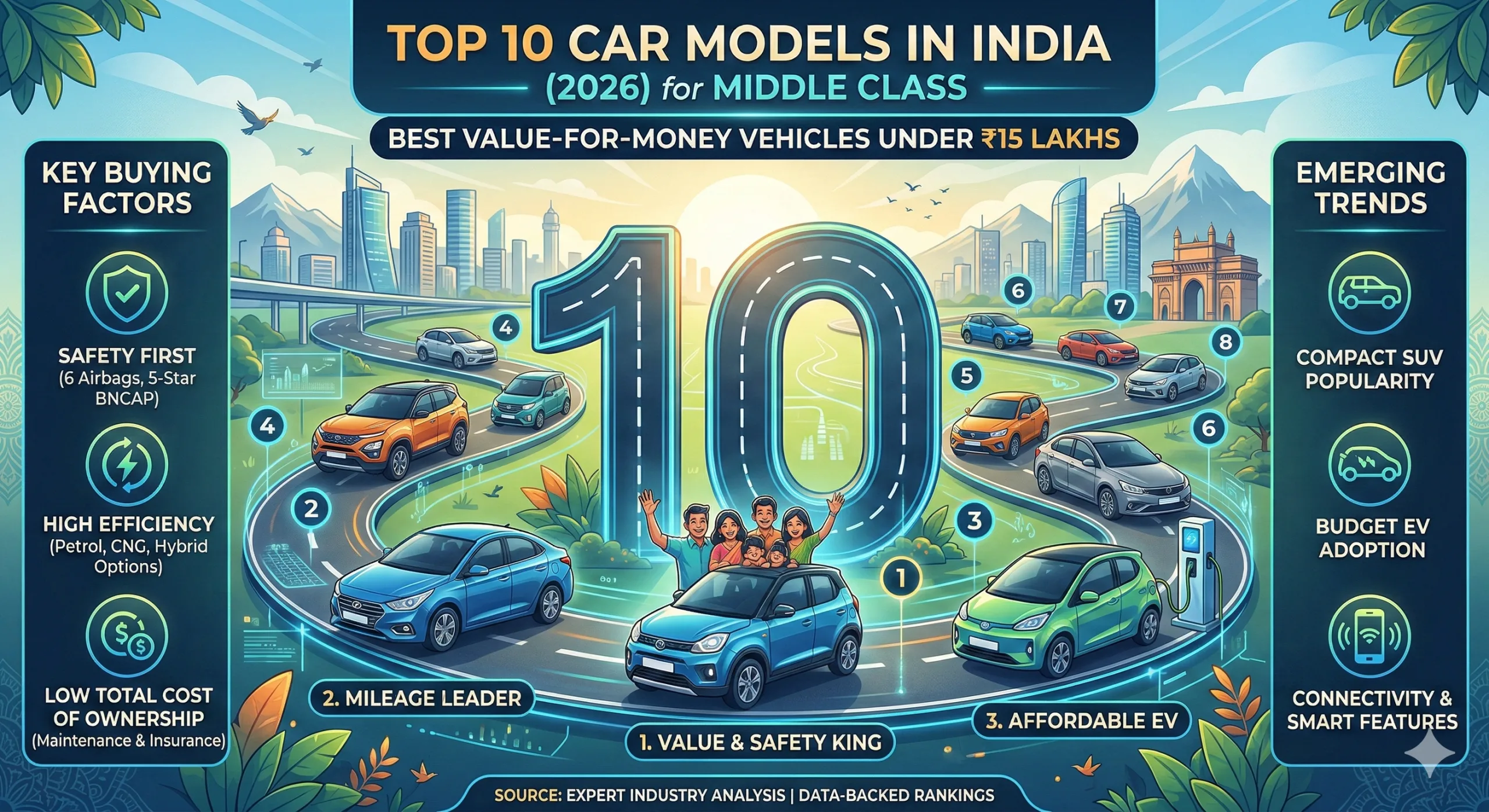
Want the top 10 car model in india 2026 for middle class families? We rank the safest, most fuel-efficient vehicles under ₹15 lakh. Stop guessing. Read this.
3️⃣ Introduction
Buying a car in India right now is a financial trap. Showroom prices look attractive. But on-road taxes and hidden fees quietly destroy your budget.
If you are looking for the top 10 car model in india 2026 for middle class buyers, the answer has shifted. You no longer have to choose between a cheap tin can or an overpriced luxury SUV. Vehicles like the new Skoda Kylaq and the Tata Punch EV offer five-star safety and low running costs well under the ₹12 lakh mark. The market is forcing brands to deliver actual value.
A “middle-class” car simply means high utility, low maintenance, and maximum safety. We analyzed the February 2026 sales data, Bharat NCAP crash tests, and real-world fuel efficiency to build this definitive list. Here is exactly what you should buy.
4️⃣ Market Friction
Finding value in 2026 is brutal. Middle-class buyers face overlapping traps:
The Tax Burden: Road taxes and GST push sub-4-meter cars heavily over budget. A ₹9 lakh car quickly becomes ₹11 lakh on-road.
Safety vs. Price: Six airbags are the new standard. But legacy brands quietly cut structural corners to offset this cost.
Fuel Volatility: Petrol sits at premium rates. Choosing between a ₹1 lakh factory CNG kit or a ₹2 lakh EV premium paralyzes buyers.
Feature Bloat: Dealerships push expensive sunroofs and ADAS features. You pay for tech you will rarely use in heavy city traffic.
Keep it simple. Buy for your daily commute, not an annual road trip.
5️⃣ Strategic Fixes
The smartest way to buy is prioritizing Total Cost of Ownership (TCO) over flashy brochures. You need a structural tank that sips fuel.
Here are the exact models dominating the Indian middle-class segment in 2026.
The Heavy Hitters
1. Tata Punch EV: Starts at ₹8.09 Lakh. The undisputed king of the urban commute. Zero emissions. Low running costs.
2. Skoda Kylaq: Starts at ₹7.59 Lakh. European build quality enters the budget chat. It packs a 1.0L TSI engine and a 5-star BNCAP rating.
3. Maruti Suzuki Dzire (New Gen): The taxi stigma is gone. The Z12E engine gets 25+ km/l. It finally secured a 5-star safety rating.
4. Mahindra XUV 3XO: Starts at ₹7.37 Lakh. Offers the widest range of engines. Heavy, safe, and aggressively priced.
5. Nissan Gravite: Launched in February 2026 at ₹5.65 Lakh. A highly practical 7-seater MUV that undercuts the Ertiga entirely.
The Versatile Choices
6. Kia Syros: Starts at ₹8.67 Lakh. A premium sub-compact offering six airbags as standard and heavy tech integration.
7. Tata Nexon: Starts at ₹7.32 Lakh. The reigning bestseller. Available in petrol, diesel, EV, and CNG.
8. Renault New Duster: Arriving March 2026. Expected under ₹10 Lakh. The legend returns with strong hybrid tech.
9. Maruti Suzuki Victoris: A premium mid-size SUV experience for the middle class. Sibling to the Grand Vitara. Excellent hybrid mileage.
10. Maruti Suzuki Fronx: The crossover that killed the premium hatchback. Reliable, stylish, and cheap to fix.
6️⃣ Comparison Matrix
| Factor | Legacy Buying Approach | Modern Buying Approach (2026) | Impact |
| Safety | Look for 2 airbags | Demand 6 airbags + 5-Star BNCAP | Survive highway accidents |
| Fuel | Default to Petrol | Evaluate EV, CNG, or Strong Hybrid | Cut running costs by 40% |
| Body Type | Sedans and Hatchbacks | Micro-SUVs and Crossovers | Better ground clearance |
| Budgeting | Ex-showroom focus | On-road + 5-year maintenance focus | Avoid loan defaults |
7️⃣ Data Insights
The Indian buyer is getting smarter. Look at the shift in January 2026 sales data:
Tata Nexon: 23,365 units sold
Maruti Dzire: 19,629 units sold
Tata Punch: 19,257 units sold
Hatchbacks are dying. Micro-SUVs and compact sedans are taking over. This means buyers are willingly paying a slight premium for ground clearance and boot space. The demand for sub-4-meter vehicles is at an all-time high because they perfectly balance tax benefits with family utility.
8️⃣ India Market Shifts
The top 10 car model in india 2026 for middle class buyers is shaped by strict local policies.
The government’s push for Bharat NCAP has terrified manufacturers into dropping unsafe chassis designs. Meanwhile, states like Haryana and Maharashtra are heavily subsidizing EVs. If you live in a Tier 1 city, ignoring an EV like the Punch EV or the upcoming Maruti e-Vitara is a financial mistake. Traffic is worse. Automatic transmissions are no longer a luxury; they are a medical necessity for your left knee.
9️⃣ Implementation
Do not walk into a dealership blind. Follow this workflow:
Assessment: Calculate your daily running. Over 40km a day? Buy EV or CNG. Under 20km? Stick to petrol.
Strategy: Cap your on-road budget strictly. A ₹12 lakh loan at 9% will bleed your monthly income.
Execution: Test drive the car with your family inside. Check the AC performance in the second row.
Optimization: Decline dealership insurance. Buy it directly from a provider online to save up to 30%.
Monitoring: Keep strict track of your first three free service intervals.
🔟 FAQs
FAQ 1: Which is the best car for a middle-class family in 2026?
The Tata Punch and Skoda Kylaq are currently the best options. They offer 5-star BNCAP safety, excellent ground clearance, and sit comfortably in the ₹7–10 lakh on-road bracket.
FAQ 2: Are EVs practical for a single-car middle-class family?
Yes. Modern budget EVs like the Tata Punch EV offer real-world ranges of 250+ km. If you have dedicated parking for a home charger, they reduce monthly fuel costs from ₹6,000 to roughly ₹800.
FAQ 3: Should I buy a CNG car or a Petrol car in India?
Buy CNG if your daily commute exceeds 40 km. Factory-fitted CNG cars from Tata and Maruti now use dual-cylinder technology, meaning you no longer have to sacrifice your entire boot space.
FAQ 4: Why are car prices increasing so much in India?
The government mandates stricter emission norms (BS6 Phase 2) and mandatory safety features like six airbags. Combined with high GST and road taxes, the base cost of manufacturing and registering vehicles has fundamentally increased.
Before heading to the showroom, you need to sort your finances. Check out our [Insert Link to Car Loan Guide] to understand hidden bank fees. If you are leaning toward battery power, review our breakdown of the [Insert Link to Best EVs 2026]. Finally, never compromise on a chassis—read our guide on [Insert Link to BNCAP Ratings Explained] to know what crash test scores actually mean.