

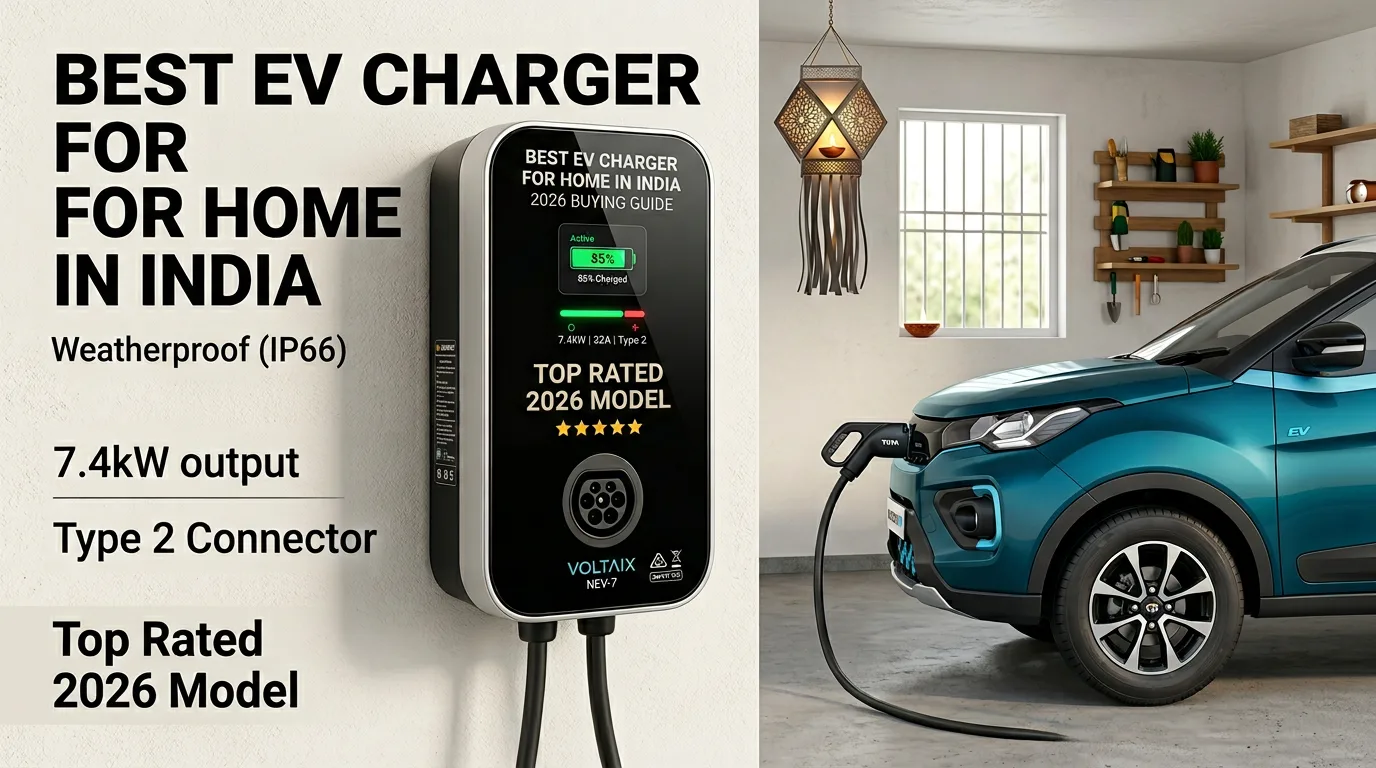
Need the best EV charger for home in India? We break down 7kW upgrades, Exicom hardware, and hidden grid costs so you can charge faster and safer in 2026.
Introduction
Indian EV sales crossed 1.5 million units last year. But the home charging experience remains broken. Dealerships hand you a heavy cable and make empty promises. Now you are stuck waiting 14 hours for a full battery.
The best EV charger for home in India is a dedicated 7.2kW or 11kW AC wallbox. It cuts your charging time in half. Relying on a standard 15-amp wall socket is a massive mistake. It exposes your ₹15 lakh vehicle to power surges and melted wiring.
You bought an electric car to save time and money. Do not let cheap infrastructure ruin the experience.
Market Friction
Charging an EV at home in India involves specific headaches. Buyers constantly run into these issues:
Abysmal Speeds: The free 3.3kW portable charger takes overnight—and then some—to fill a standard 40kWh battery.
Grid Overload: Older apartment buildings simply lack the sanctioned load. Tripping the main breaker is a daily reality.
Hidden Installation Costs: Dealers rarely explain wiring costs. Copper cabling for a 50-meter parking run easily exceeds ₹15,000.
Hardware Failures: Cheap, unbranded chargers fry under the intense Indian summer heat.
Dealerships mask these realities. They want a quick sale. You get stuck with the aftermath.
Strategic Fixes
You solve this by treating your charger as a primary home appliance. Stop treating it like a glorified phone cable.
The 7.2kW Upgrade
You must install a 7.2kW fast charger. A brand like Exicom dominates this space for a reason. Their hardware handles voltage drops without bricking your vehicle’s onboard computer.
Load Extension
Apply for an electricity load extension immediately. Most Indian homes max out at 5kW. A 7.2kW charger requires a sanctioned load of at least 10kW to run safely alongside your air conditioners.
Dedicated Metering
Separate your vehicle from your home appliances. States like Haryana and Delhi offer EV-specific meters. These charge a flat, subsidized per-unit rate.
Comparison Matrix
| Factor | Legacy Approach | Modern Approach | Impact |
| Cost | Free (In-box cable) | ₹40,000+ Upfront | Painful initially, saves hours daily |
| Efficiency | 3.3kW trickling | 7.2kW to 11kW AC | Halves total charging time |
| Scalability | Standard 15A socket | Dedicated EV meter | Zero grid overload |
| Risk | High fire risk over 12 hours | Built-in surge protection | Total peace of mind |
Data Insights
Look at the real-world numbers for a popular vehicle.
Tata Nexon EV (40.5 kWh) 10% to 100% Charge Time:
15A Socket: 15 Hours
3.3kW Box: 11 Hours
7.2kW Exicom Charger: 6 Hours
Numbers do not lie. A 7.2kW charger means you plug in after dinner and wake up to 100%. The legacy cable forces you to plan your entire weekend around your battery percentage.
Home Charging in India
The best EV charger for home in India depends heavily on local infrastructure.
Discoms are upgrading transformers rapidly in Tier 1 cities. But power quality fluctuates wildly. A smart charger with a dedicated app monitors this flow. If the voltage drops dangerously low, the charger cuts power. This saves your car. Listen to this recent industry podcast to understand how poor grid quality degrades battery health.
Implementation
Getting this right requires three non-negotiable steps. Do not skip them.
Assessment: Check your current electricity bill. Note your sanctioned load limit.
Strategy: Choose your hardware. An Exicom wallbox provides the best durability for Indian weather conditions.
Execution: Hire certified electricians. Never let a local handyman splice high-voltage copper wires.
Optimization: Set a charging schedule via the app. Charge between 1 AM and 5 AM when the grid is stable.
Monitoring: Review your monthly electricity bill. Ensure the EV meter tariff is actively applied.
FAQs
FAQ 1: Which is the best EV charger for home in India?
Exicom and Tata Power currently manufacture the most reliable 7.2kW AC wallbox chargers for the Indian market. They feature robust IP67 weather ratings, app connectivity, and built-in surge protection tailored for local grid fluctuations.
FAQ 2: Can I plug my EV directly into a regular wall socket?
You can, but you shouldn’t. A standard 15-amp socket maxes out at 3.3kW. It takes over 14 hours to charge a modern EV. Continuous high-load draw also risks melting the socket and causing electrical fires.
FAQ 3: How much does a 7.2kW EV charger cost in India?
A branded 7.2kW charger costs between ₹40,000 and ₹55,000. Installation and extra copper cabling will add another ₹5,000 to ₹15,000 depending on the distance from your main electrical panel.
FAQ 4: Do I need permission from my society to install an EV charger?
Yes. You must obtain an NOC (No Objection Certificate) from your Resident Welfare Association (RWA). The government mandates that RWAs cannot unreasonably deny this request, provided you pay for the dedicated wiring.
Market Analysis
For a deeper dive into how bad wiring destroys vehicle value, watch this video analysis on modern power draw. Educate yourself before the dealership tricks you.