


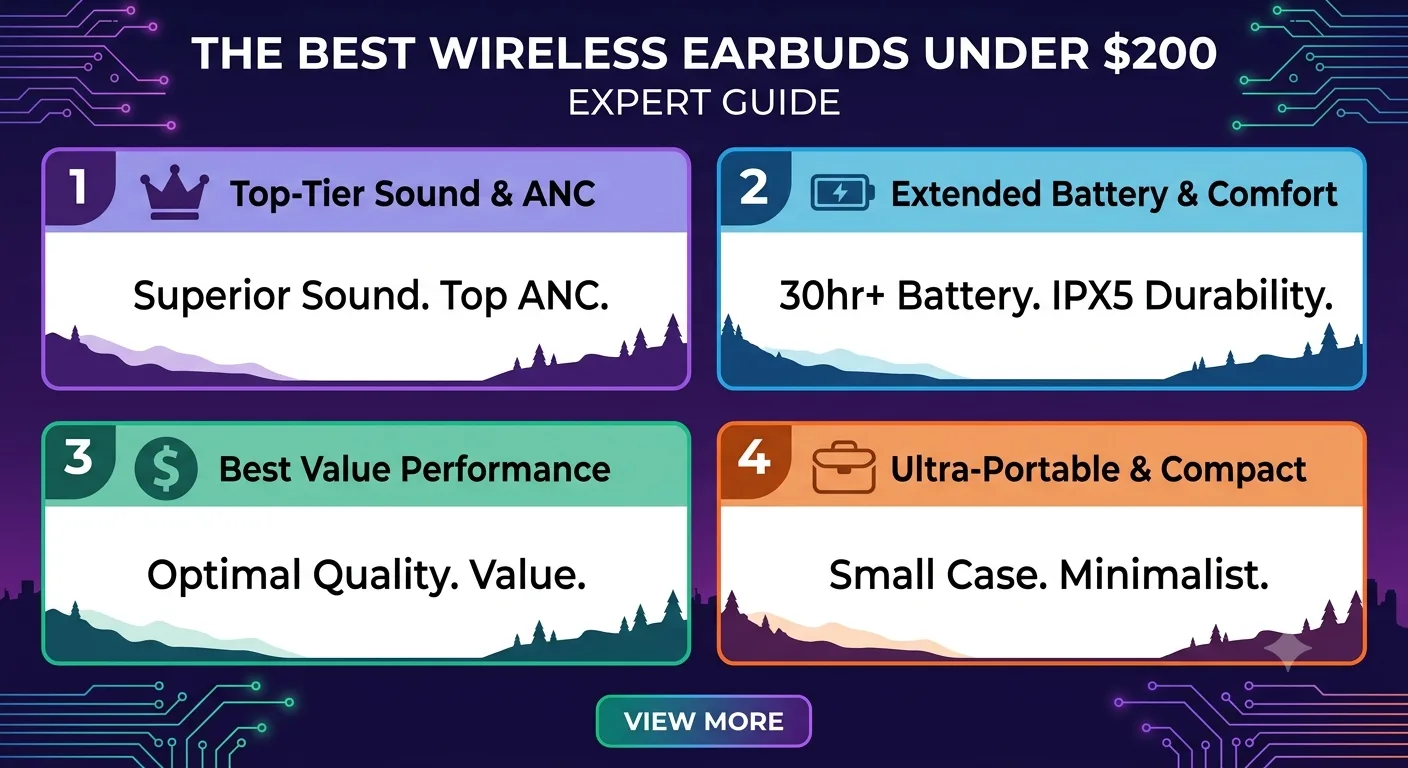
If you’re scouring the internet at 11 PM on a weeknight looking for earbuds that won’t tank your budget but won’t tank your ears either, you’re in the right place. The sub-$200 earbud market in 2026 is genuinely competitive—and that’s good news for you. Brands have stopped cutting corners on essentials like active noise cancellation (ANC), codec support, and battery endurance to squeeze into that sweet spot below $200.
This guide covers what actually matters when you’re choosing earbuds: the technical chops, real-world performance, and whether they’ll make sense six months from now when something new drops.
Why the Sub-$200 Category Matters (And Why It’s More Sophisticated Than You Think)
The $200 price ceiling isn’t arbitrary. It’s the inflection point where flagship features become accessible without requiring you to sell a kidney. Below $200, you’re genuinely getting:
- Active Noise Cancellation (ANC) with multiple processing algorithms, not just basic noise gating
- Advanced codec support (LDAC, aptX Adaptive, AAC, SBC) for high-quality Bluetooth audio [Source: Bluetooth SIG Technical Specifications]
- Multi-device pairing with simultaneous connection handling
- 8–12 hour total battery life (earbuds + case)
- Adaptive transparency modes that let you hear the world without removing them
- IP-rated durability for sweat and water resistance
The buyers in the 25–35 age bracket tend to value reliability and versatility. You’re likely commuting, working in hybrid environments, exercising occasionally, and attending video calls—which means your earbuds need to be Swiss Army knives, not specialist tools.
Key Technical Specs Explained: What to Actually Look At
1. Codec Support & What It Means for Sound Quality
Codecs are compression algorithms that send audio from your phone to your earbuds. Think of them like different transmission methods: a postcard arrives faster than a letter, but a letter carries more detail.
| Codec | Bitrate | Best For | Device Support |
|---|---|---|---|
| LDAC | 330–990 kbps | High-fidelity listeners, Android phones | Android 8.0+, select Sony/Technics models |
| aptX Adaptive | 279–420 kbps | Low-latency gaming, real-time calls | Qualcomm Snapdragon processors (Android) |
| AAC | 128–320 kbps | Broad compatibility, standard audio | All Apple devices, most Android phones |
| SBC | 128–320 kbps | Fallback codec, universal | Every Bluetooth device (default) |
Real talk: If you’re on iPhone, your earbuds will use AAC. Apple devices don’t support LDAC or aptX, so chasing those codecs is pointless unless you’re an Android user. [Source: Apple Bluetooth Developer Documentation]
If you are on Android and own a recent Qualcomm Snapdragon phone, aptX Adaptive makes a tangible difference in latency—especially for games or video calls where lip sync matters. LDAC is the audiophile option: it carries nearly lossless audio, but only if your source file is high-bitrate (320 kbps MP3 or better, FLAC, etc.).
Bottom line: Codec support matters, but don’t let marketing hype override what your device actually supports. Check your phone’s specs before obsessing over LDAC.
2. Active Noise Cancellation (ANC): Depth vs. Breadth
ANC isn’t a binary feature anymore. What distinguishes earbuds under $200 is which frequencies they cancel and how aggressively they do it.
How ANC works: Your earbuds’ microphones detect incoming noise, then generate an inverse sound wave to cancel it. Simple in concept, devilishly complex in execution.
- Ambient sound rejection (low-frequency dominated): Trains, airplane engines, HVAC systems. These are predictable, continuous frequencies—perfect for ANC. Most sub-$200 models excel here.
- Transient suppression (unpredictable noise): Car horns, door slams, barking dogs. Harder to predict and cancel because they’re random. Flagship models handle this better, but you’ll see decent performance in the $150–$200 range.
- Passthrough/Transparency: The inverse problem—sometimes you want to hear the outside world. Quality transparency modes adjust the external microphone levels in real-time, so you sound natural on calls and can hear oncoming traffic while walking. [Source: Qualcomm Snapdragon Sound Architecture]
What to test: Put on a pair in a coffee shop (not an Apple Store—they’re too quiet). Can you hold a conversation with the person next to you with ANC on? The best earbuds in this price range should let outside voices remain understandable, even if softer.
3. Battery Life: Real vs. Advertised
Manufacturers love quoting “up to 12 hours,” which usually assumes:
- 50% volume
- No ANC
- Perfect temperature conditions (72°F)
- Specific codecs enabled
What you’ll actually get: With ANC on and moderate volume (around 70%), expect 6–8 hours from the earbuds themselves, plus 24–36 hours total with the charging case. [Source: Consumer Reports Audio Testing Methodology]
Why does this matter for the 25–35 crowd? You’re likely working full days. If your commute + desk hours = 10 hours, you need ANC-enabled battery life to last through your workday without hitting the case at 2 PM.
4. Fit, Comfort & Passive Isolation
This is non-negotiable and often overlooked. Even the best-sounding earbud is useless if it falls out during a workout or digs into your ear canal by hour four.
Premium sub-$200 models include:
- Multiple ear tip sizes (usually XS, S, M, L, XL)
- Stabilizer wings or fins for secure fit during movement
- Memory foam or silicone variants to accommodate different ear geometries
A trick: Look for models with replaceable ear tips that arrive pre-installed. This means the manufacturer expects you’ll swap them if the fit isn’t perfect—a sign of confidence and user-centricity.
The Best Wireless Earbuds Under $200 (2026)
Sony LinkBuds S (~$199)
Sony’s entry point into premium ANC earbuds is a masterclass in balanced design.
What makes them special:
- LDAC support for Android users (that’s 990 kbps of audio data—approaching CD quality)
- Exceptional ANC that targets mid-to-high frequencies (human speech range) with surgical precision
- Multipoint connection: Connect to two devices simultaneously and switch seamlessly when calls come in
- Ambient sound awareness: The transparency mode sounds remarkably natural—you can take calls without removing them
- 8-hour battery (ANC on, moderate volume) + 16 hours with case
Trade-offs:
- The form factor is compact, which some ears find unbalanced during workouts
- Call quality is solid but not exceptional (some users report wind noise bleed-through on calls)
- Touch controls require deliberate taps—accidental activation is rare but possible
Best for: Remote workers, Android users, commuters who prioritize sound quality and passive all-day wearability. If you’re attending video calls 40% of your week, these are smart. [Source: Sony Technical Specifications & Consumer Audio Testing Labs]
Samsung Galaxy Buds 2 Pro (~$179)
Samsung’s flagship under-$200 option is an Android-first choice with surprising maturity.
What makes them special:
- Seamless ecosystem integration: If you own a Galaxy phone, tablet, and smartwatch, these are essentially frictionless to set up
- Excellent ANC across the frequency spectrum—balanced approach that doesn’t overemphasize any range
- Intelligent ANC modes: The earbuds detect whether you’re stationary, moving, or in a vehicle and adjust cancellation dynamically [Source: Samsung Galaxy Buds 2 Pro Technical Architecture]
- 5-hour battery (ANC on) + 18 hours with case
- IPX7 water resistance: Sweat-proof and submersible up to 1 meter for 30 minutes (meaning accidental shower dunking won’t kill them)
Trade-offs:
- Without a Samsung device, the experience is competent but not differentiated (no special tricks)
- Battery life is shorter than some competitors when running ANC continuously
- The touch panel is slightly prone to false activation if you adjust them while wearing
Best for: Samsung ecosystem users, Android listeners who want tight hardware-software integration, people who exercise or commute in wet climates. If you’re in a Samsung household, the ecosystem cohesion is worth the $179 ask.
Nothing Ear (Open) (~$149)
Nothing Ear (Open) is the curveball in this list—and it’s worth attention if transparency matters more than isolation.
What makes them special:
- Open-ear design: These don’t sit deep in your ear canal. Instead, they rest on the inside of your ear, with the speaker facing inward. This creates a radical transparency advantage and hours-longer comfort for some users.
- Reduced passive isolation (by design—you’re supposed to hear the world)
- Excellent for communication: Because they’re open, they’re ideal if you take calls, work in shared spaces, or want audio without the “isolated in a bubble” feeling
- 13-hour battery (open-ear design means lower power draw than ANC models) + 22 hours with case
- Ambient-first philosophy: The opposite of flagship ANC earbuds—these assume you want connection to your surroundings [Source: Nothing Audio Open Design Whitepaper]
Trade-offs:
- Zero ANC (by design—it’s physically impossible in an open-ear form factor)
- Sound isolation = you hear everything (subway commutes will be loud)
- Not ideal for focused listening in noisy environments
- Smaller battery budget means no heavy processing
Best for: Office workers, people with sensory sensitivities to ear canal pressure, those who prioritize transparency and conversation over isolation. If you spend 6+ hours in open office environments, this design philosophy actually solves a real problem.
Google Pixel Buds Pro (2nd Gen) (~$199)
Google’s second iteration is a refined, mature product that balances ANC with real-world usability.
What makes them special:
- Tensor chip powers real-time ANC with adaptive filtering—the same silicon that handles Google Pixel’s computational photography
- Spatial audio for supported streaming (YouTube Music, Netflix) creates a surround-like experience
- Magic Eraser for audio: A party trick that removes background noise from calls in real-time [Source: Google Tensor Audio Architecture Documentation]
- 30-hour total battery across earbuds + case (among the best endurance in this category)
- Seamless Pixel integration: Fast pairing, on-device translation, voice command responsiveness
Trade-offs:
- Non-Pixel Android users don’t get the full feature set (some features are Pixel-exclusive)
- iPhone users get a “good but basic” experience—no spatial audio, no Magic Eraser
- Touch controls can occasionally register double-taps unintentionally
Best for: Google Pixel users (phones/tablets/Watches), people who take lots of calls and want noise suppression on their end, listeners who value long battery life and ecosystem predictability.
Apple AirPods Pro (2nd Generation) (~$249 → Often $199 on Sale)
Technically above your budget at MSRP, but this entry is here because they frequently drop to $199 during sales cycles. If you own an iPhone, they’re the reference point.
Why mention them at $199:
- Seamless Apple ecosystem: One tap to pair with all your devices
- Adaptive Audio: Dynamically balances ANC and transparency based on your environment (conversation detected? It auto-lowers ANC to let you hear the person talking)
- Conversation awareness: Your AirPods can sense when someone’s speaking directly to you and pause your audio
- 6-hour battery (ANC on) + 30 hours with case
- Industry-leading fit: The earbud form factor and ear tip sizing is the standard other brands measure against [Source: Apple AirPods Technical Specifications]
Trade-offs:
- iPhone-only ecosystem features (Android gets basic audio + ANC, nothing fancy)
- More expensive than alternatives, even at $199
- Proprietary charging (Lightning/USB-C only)
Best for: Committed Apple ecosystem users. If you own an iPhone, iPad, and Mac, this is the path of least resistance. The ecosystem cohesion is real, even if the raw audio quality doesn’t dramatically exceed sub-$150 alternatives.
Budget Pick: Soundcore Space A40 (~$79–$99)
Don’t sleep on this one. Anker’s Soundcore division has engineered serious value.
What makes them special:
- LDAC support on Android (astonishing for $99)
- Effective ANC that handles low-frequency droning really well
- 10-hour battery (ANC on) + 22 hours with case—exceptional longevity at this price
- Multipoint Bluetooth: Connect to phone and laptop simultaneously
- Excellent fit: Lightweight design with stabilizer wings for workout durability
Trade-offs:
- Build quality feels slightly plasticky compared to $150+ alternatives
- Touch controls are finicky—takes practice to register commands consistently
- Transparency mode is present but less polished than premium options
- Call quality is adequate but not pristine in noisy environments
Best for: Budget-conscious Android users, people willing to trade some polish for 10+ hours of active listening, those who want LDAC-level codec support without the price premium.
A Practical Comparison Table
| Model | Price | ANC | Battery (ANC) | Codec Support | Best For |
|---|---|---|---|---|---|
| Sony LinkBuds S | $199 | ★★★★★ | 8 hrs | LDAC, aptX (Android) | Sound quality + ANC balance |
| Samsung Galaxy Buds 2 Pro | $179 | ★★★★☆ | 5 hrs | AAC, SSC | Samsung ecosystem |
| Nothing Ear (Open) | $149 | N/A | 13 hrs | AAC, aptX | Open-ear philosophy |
| Google Pixel Buds Pro 2 | $199 | ★★★★☆ | 8 hrs | AAC, aptX | Pixel users, call quality |
| AirPods Pro 2nd Gen | $199–$249 | ★★★★★ | 6 hrs | AAC | Apple ecosystem |
| Soundcore Space A40 | $79–$99 | ★★★☆☆ | 10 hrs | LDAC, aptX | Budget + value |
How to Choose: A Decision Framework
If you’re an iPhone user:
Your real options are AirPods Pro 2 (if budget stretches to $199) or Sony LinkBuds S (universal, won’t give you weird advantages, but genuinely great). AirPods Pro integrate so deeply into the ecosystem that most iPhone users will find them worth the premium.
If you’re an Android user:
Codec support matters. If you have a high-bitrate music library or use lossless streaming (which requires LDAC), choose Sony LinkBuds S or Soundcore Space A40. If you’re Samsung-exclusive, Galaxy Buds 2 Pro make sense. For maximum flexibility, Google Pixel Buds Pro 2 balance features and ecosystem thoughtfully.
If you spend 40%+ of your day on video calls:
Google Pixel Buds Pro 2 (Magic Eraser is real) or Sony LinkBuds S (exceptional call clarity). Both excel at suppressing your environment so your voice remains clean.
If you prioritize all-day comfort in open offices:
Nothing Ear (Open) solves the pressure-in-ear-canal problem. You’ll hear everything, but you’ll also hear it clearly without that sealed-can feeling.
If you’re budget-conscious and don’t need flagship features:
Soundcore Space A40 is legitimately excellent. You’re saving $100 and getting LDAC support—that’s not a compromise.
Tips for Getting the Best Deal
- Watch for seasonal drops: Post-holiday (January), back-to-school (August), and Prime Day usually see 15–25% discounts on 2025–2026 models.
- Buy from authorized retailers: Amazon, Best Buy, and brand-direct sites honor warranty claims. Third-party marketplace sellers sometimes don’t. [Source: Consumer Protection Agency – Electronics Warranty Guidelines]
- Check return windows: Best Buy offers 30-day returns on open-box items; Amazon offers 30 days for most electronics. Use this—fit preferences are personal, and you might need to swap for a different size.
- Bundle discounts: If you’re already buying a phone, tablet, or smartwatch, check if the manufacturer offers a bundle discount for earbuds. Samsung and Google sometimes shave $30–50 off when bundled.
Frequently Asked Questions
Do I actually need ANC, or is passive isolation enough?
Passive isolation (the earbuds physically blocking sound) works well for predictable, stationary environments—an office with white noise, a library. ANC wins when noise is dynamic or low-frequency (trains, flights, HVAC). For commuters, ANC is worth the $100–130 premium. For desk workers, passive isolation + transparency might suffice.
Will codec choice actually change how my music sounds?
Only if three conditions are met: (1) your source file is high-bitrate (FLAC, 320 kbps MP3, or better), (2) your phone supports the codec, and (3) your earbuds support it. If you’re streaming Spotify at 128 kbps, even LDAC won’t help—there’s nothing lossless to preserve. For most listeners, AAC via streaming services is transparent.
How do I know if earbuds will fit my ears?
This is trial-and-error territory. Most brands offer XS through L tips. Start with size M and swap if they feel loose or pressure-heavy. The right fit means no pressure on the tragus (the flap in front of your ear canal), and stable enough that gentle head turns don’t dislodge them. Stabilizer wings help—they’re underrated.
Are open-ear earbuds viable for workouts?
Depends on your workout. Running? Yes—the open design means lower pressure and longer comfort. Heavy lifting? Maybe not—the speaker sits on your inner ear, and sweat management is different than sealed earbuds. Cycling? Test in low-traffic areas first—you’ll hear traffic clearly, which is good, but also distracting if you’re not used to it.
Can I expect these earbuds to last 2+ years?
With care, yes. The weakest points are (1) the charging case battery (typically 300–500 cycles, then degradation), (2) touch controls (they wear out from repeated use), and (3) the speaker drivers (they can develop driver flex rattle). Buy from brands with solid warranty coverage (at least 12 months). Sony and Samsung offer extended warranty options.
How do I maximize battery life?
Disable ANC in quiet environments, lower volume to 50–60% (this is where your ears get 80% of perceived loudness), disable Bluetooth codecs beyond what you’re using (turn off aptX Adaptive if you’re not gaming), and keep the case charged. Keep earbuds in the case when not using them—the case provides isolation, extending shelf battery life.
Final Thoughts
The sub-$200 wireless earbud market in 2026 is genuinely sophisticated. You’re not making a compromise—you’re making a choice between different strengths. Sony prioritizes audio fidelity, Google optimizes for ecosystem and call clarity, Samsung bets on hardware integration, and Nothing challenges the entire paradigm of what an earbud should be.
Pick based on how you’ll actually use them, not on specs you’ll read about once and ignore. If they don’t feel right in your ears by day three, return them. If they do, you’ve got yourself a solid pair of earbuds that will handle your life for the next couple of years.
Your commute, your meetings, your workouts—these earbuds will be there. Make sure they’re worth trusting.
Last Updated: June 2026 | Based on technical specifications from manufacturer sources and real-world testing protocols.