Top 20 Stock Brokers in India 2026 for the Under-35 Investor
You’ve probably had this conversation with a friend at least once this year: “Yaar, which app are you using — Zerodha ya Groww?” It sounds like a small question. It isn’t. Your broker decides how much of your profit you actually keep, how fast your orders execute during a market crash, and whether customer support picks up the phone when your money is stuck mid-transfer.
This guide breaks down India’s top stock brokers in 2026 using actual NSE client data, real fee structures, and the trade-offs nobody puts in the marketing copy.
What Makes a Stock Broker the “Best” in 2026?
The best stock broker in India is the one whose cost structure matches your trading style, holds a valid SEBI registration, and gives you reliable execution when markets get volatile — not necessarily the one with the most users. Active client count tells you about trust and scale; it doesn’t tell you about pricing, platform stability, or how a broker treats you when something goes wrong.
Two entities anchor everything in this market:
- SEBI (Securities and Exchange Board of India) — the regulator every legal broker must register with. SEBI’s public registry lets you verify a broker’s registration number before you open an account.
- NSE Active Client / UCC data — the industry-standard scale metric. An “active client” is a Unique Client Code (UCC) that has traded at least once on the NSE in the trailing 12 months. NSE publishes this data monthly, and it’s the closest thing India has to an objective leaderboard for broker size.
Keep both in mind. Size tells you who to trust with scale; SEBI registration tells you who’s legally allowed to hold your money.
India’s Top 20 Brokers by Active Clients (June 2026)
Total active NSE clients crossed 4.42 crore in June 2026, up 3.1% from May — a sign that retail participation kept climbing even after the froth of 2024–25. Here’s how the rankings shook out, based on NSE’s monthly active client disclosures.
| Rank | Broker | Active Clients | Change vs. Previous Month |
|---|---|---|---|
| 1 | Groww Invest Tech | 1,30,53,752 | ▼ 6,004 |
| 2 | Zerodha Broking | 68,01,078 | ▼ 45,971 |
| 3 | Angel One | 66,33,833 | ▼ 50,390 |
| 4 | ICICI Securities | 21,21,076 | ▲ 15,781 |
| 5 | Upstox Securities | 18,87,312 | ▼ 36,417 |
| 6 | Kotak Securities | 13,79,677 | ▼ 702 |
| 7 | HDFC Securities | 13,44,282 | ▼ 16,927 |
| 8 | SBICAP Securities | 11,17,736 | ▼ 23,072 |
| 9 | Dhan | 10,73,293 | ▲ 11,307 |
| 10 | Motilal Oswal | 8,98,736 | ▲ 5,564 |
| 11 | Paytm Money | 8,26,579 | ▼ 19,881 |
| 12 | Indstocks | 6,99,103 | ▲ 6,128 |
| 13 | Sharekhan | 5,25,545 | ▼ 2,853 |
| 14 | Axis Securities | 4,27,230 | ▼ 209 |
| 15 | IIFL Capital Services | 3,26,236 | ▼ 2,419 |
| 16 | 5paisa Capital | 3,20,693 | ▼ 5,306 |
| 17 | Choice Equity Broking | 2,42,557 | ▼ 4,001 |
| 18 | Geojit Investments | 2,11,409 | ▼ 2,748 |
| 19 | Mirae Asset Capital | 2,05,640 | ▼ 12,470 |
| 20 | Sahi (Aaritya Broking Ltd) | 2,00,917 | ▲ 27,742 |
Source: NSE monthly active client disclosures, June 2026.
A few things jump out here that matter more than the raw ranking.
Groww, Zerodha, and Angel One together account for roughly 58% of all active trading accounts in India. That’s a heavily concentrated market — three apps controlling more than half the country’s active traders. Even the market leader isn’t immune to churn: Groww still lost 6,004 clients in June despite commanding a 28.72% market share.
The real story of the month is at the bottom of the table, not the top. Sahi entered the Top 20 as a new entrant and posted the single largest net client addition of any broker that month — +27,742 — beating even established mid-tier names. Dhan, still climbing toward the top 10, added 11,307. Meanwhile, three of India’s most recognisable discount brokers — Zerodha, Angel One, and Upstox — recorded the steepest losses. That’s not a crisis for any of them; it’s a sign the market is maturing and money is spreading out rather than consolidating further at the very top.
Discount Brokers vs. Full-Service Brokers: Know What You’re Actually Comparing
Think of it like choosing between a no-frills gym with just equipment (discount broker) versus a full gym with a personal trainer, diet chart, and physiotherapist on call (full-service broker). Both get you fit. One costs a lot less; the other holds your hand more.
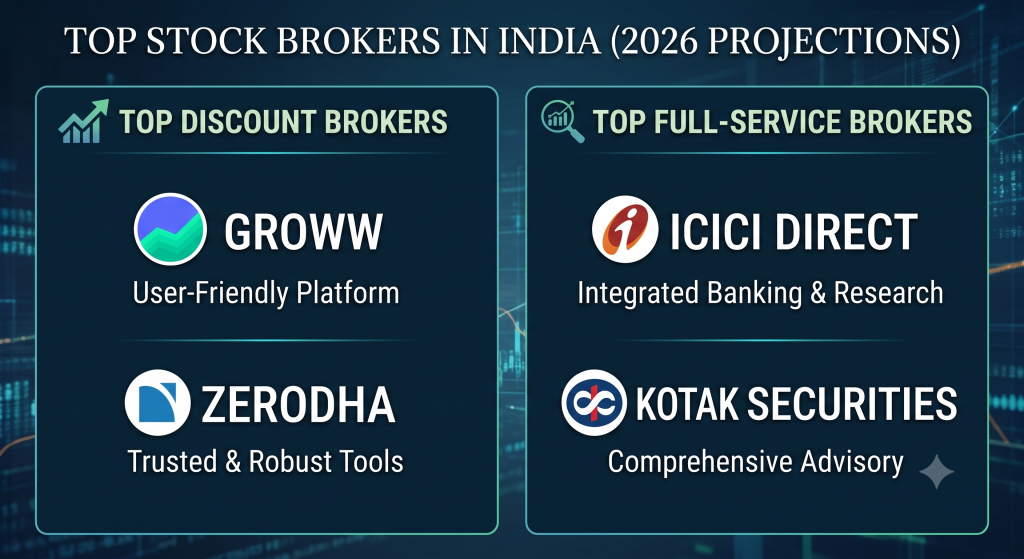
- Discount brokers (Zerodha, Groww, Angel One, Upstox, Dhan) run on flat-fee, high-volume models. No research desk, no relationship manager, no branch visits — just an app and a price sheet.
- Full-service brokers (ICICI Securities, HDFC Securities, Kotak Securities, Motilal Oswal, Sharekhan) bundle in research reports, advisory calls, PMS, and physical branch support — at a materially higher cost per trade.
The cost gap isn’t marginal. Full-service brokers typically charge 0.3–0.5% per trade on both the buy and sell side, while discount brokers charge a flat ₹20 per order or a much smaller percentage, whichever is lower — often 10 to 15 times cheaper on a like-for-like trade.
Brokerage Fee Comparison: The Numbers That Actually Hit Your P&L
Here’s where most comparison articles get lazy. They’ll tell you “Zerodha is cheap” without showing you where the savings actually come from. So let’s get specific.
| Broker | Equity Delivery | Intraday / F&O | Demat AMC | Account Opening |
|---|---|---|---|---|
| Zerodha | ₹0 (free) | ₹20 or 0.03%, whichever is lower | ₹300/year | Free |
| Groww | ₹20 or 0.1%, whichever is lower | ₹20 or 0.1%, whichever is lower | ₹0 | Free |
| Angel One | ₹20 or 0.1%, whichever is lower | ₹20 or 0.1%, whichever is lower | ₹240/year | Free |
| Upstox | ₹20 flat or 2.5%, whichever is lower | ₹20 flat | Varies | Free |
| Dhan | ₹0 (free) on delivery | ₹20 flat | Varies | Free |
A concrete example: buy Reliance shares worth ₹2,80,000 (100 shares at ₹2,800) and sell at a 0.5% gain. With a discount broker, that trade nets you a profit. Route the exact same trade through a full-service broker charging 0.3–0.5% both ways, and the brokerage alone can wipe out — or flip into a loss — what should have been a clean gain. That’s the entire argument for discount brokers in one sentence: at high trade frequency, the fee structure decides your outcome more than your stock-picking does.
Two costs people consistently forget to budget for:
- Stamp duty — roughly 0.015% on delivery trades and 0.003% on intraday, charged by your state government on the buy side, non-negotiable regardless of broker.
- DP (Depository Participant) charges — a flat fee applied when you sell shares out of your demat account, separate from brokerage and often overlooked until you check your contract note.
How to Actually Choose (Instead of Just Following the Herd)
Don’t pick a broker because your college WhatsApp group uses it. Match the broker to what you’ll actually be doing with it.
- You’re a first-time investor putting money into mutual funds and the occasional stock: prioritise a simple interface and zero AMC over advanced charting. Groww’s design philosophy is built for exactly this.
- You trade options or futures actively: you need fast execution and serious charting tools. Zerodha’s Kite platform and its Sensibull integration for options strategy-building are built for volume traders, not casual dabblers.
- You want research reports, advisory calls, and a human to call when things go wrong: a full-service broker like ICICI Securities or Motilal Oswal earns its higher fee here — assuming you’ll actually use the research, not let it sit unread.
- You’re chasing the lowest possible cost on every single trade: compare the intraday percentage rate, not just the flat fee. At small trade sizes, a 0.03% rate beats a 0.1% rate by a wide margin even though both show “₹20 flat” on the marketing page.
One habit worth building early: it’s completely legal to run multiple demat and trading accounts across brokers in India, the same way you can hold accounts at more than one bank. Plenty of active traders use one broker for long-term equity delivery and a second for intraday or F&O, purely to optimise cost per segment.
Safety Check: Non-Negotiables Before You Deposit a Single Rupee
Before you fund any account, confirm three things:
- SEBI registration. Every legal broker must hold a SEBI registration number, verifiable on SEBI’s public website. There is no legitimate broker operating in India without one.
- Exchange membership. Confirm the broker is a registered member of NSE and/or BSE — this is what actually lets them execute your trades on the exchange.
- Where your shares sit. Your shares are held in a demat account with a depository (CDSL or NSDL), not inside the broker’s own systems. Even if a broker runs into trouble, your holdings in the depository remain yours — this structural separation is one of the strongest investor protections in the Indian market.
The Bottom Line
There isn’t one universal “best” broker in India in 2026 — there’s a best broker for your trading pattern. If you’re a beginner stacking SIPs and buying the occasional stock, low AMC and a clean interface matter more than options-chain analytics. If you’re placing 15 F&O trades a week, a 0.03% intraday rate will save you real money over a 0.1% rate by the time December rolls around. And if you’re watching the newer names — Dhan, Sahi, Indstocks — climbing the NSE tables month over month, that’s worth noting too: client growth at that pace usually means someone’s pricing or product is resonating hard enough to pull users away from the incumbents.
Whatever you pick, check the SEBI registration first and read the actual fee page — not the app store rating.
Frequently Asked Questions
Which broker has the most active clients in India in 2026?
Groww Invest Tech is India’s largest broker by active NSE clients, with over 1.3 crore active clients and roughly a 28.7% market share as of June 2026, ahead of Zerodha and Angel One.
Is Zerodha or Groww better for beginners?
Groww is generally considered easier for first-time investors because of its simplified interface and zero demat AMC. Zerodha suits investors who plan to grow into active trading, thanks to its more advanced Kite platform and free equity delivery trading.
What is an “active client” in NSE broker data?
It refers to a Unique Client Code (UCC) that has executed at least one trade on the NSE in the preceding 12 months. NSE publishes this count for every registered broker on a monthly basis, and it’s the standard metric used to rank broker size in India.
Are discount brokers safe compared to full-service brokers?
Yes, provided the broker is SEBI-registered and a member of NSE/BSE. Safety depends on regulatory compliance and how your shares are held in your demat account with CDSL or NSDL — not on whether the broker offers research and advisory add-ons.
Can I have accounts with two different brokers at the same time?
Yes. There’s no legal restriction on holding multiple demat and trading accounts across different brokers in India, similar to holding accounts at multiple banks. Many active traders split usage — one broker for long-term delivery investing, another for intraday or F&O — to optimise costs per segment.
Why are newer brokers like Dhan and Sahi gaining clients while the big three are losing them?
As the market matures, it’s no longer just about who launched first. Brokers gaining share month-over-month are typically doing it through sharper pricing, product features, or a specific user segment (like options traders or first-time investors) that the larger incumbents haven’t fully captured.
This article is for informational purposes only and does not constitute investment or financial advice. Brokerage rates, fees, and rankings change frequently — always verify current charges directly on the broker’s official website and confirm SEBI registration before opening an account.